If a foreign investor runs diligence on an Indonesian coal asset, two policy numbers surface early: a share of production that cannot be exported, and a price that cannot be charged for it. The first is the Domestic Market Obligation (DMO) — the requirement that a coal producer sell part of its output inside Indonesia. The second is the domestic price cap, set at US$70 per tonne for coal sold to the power sector.
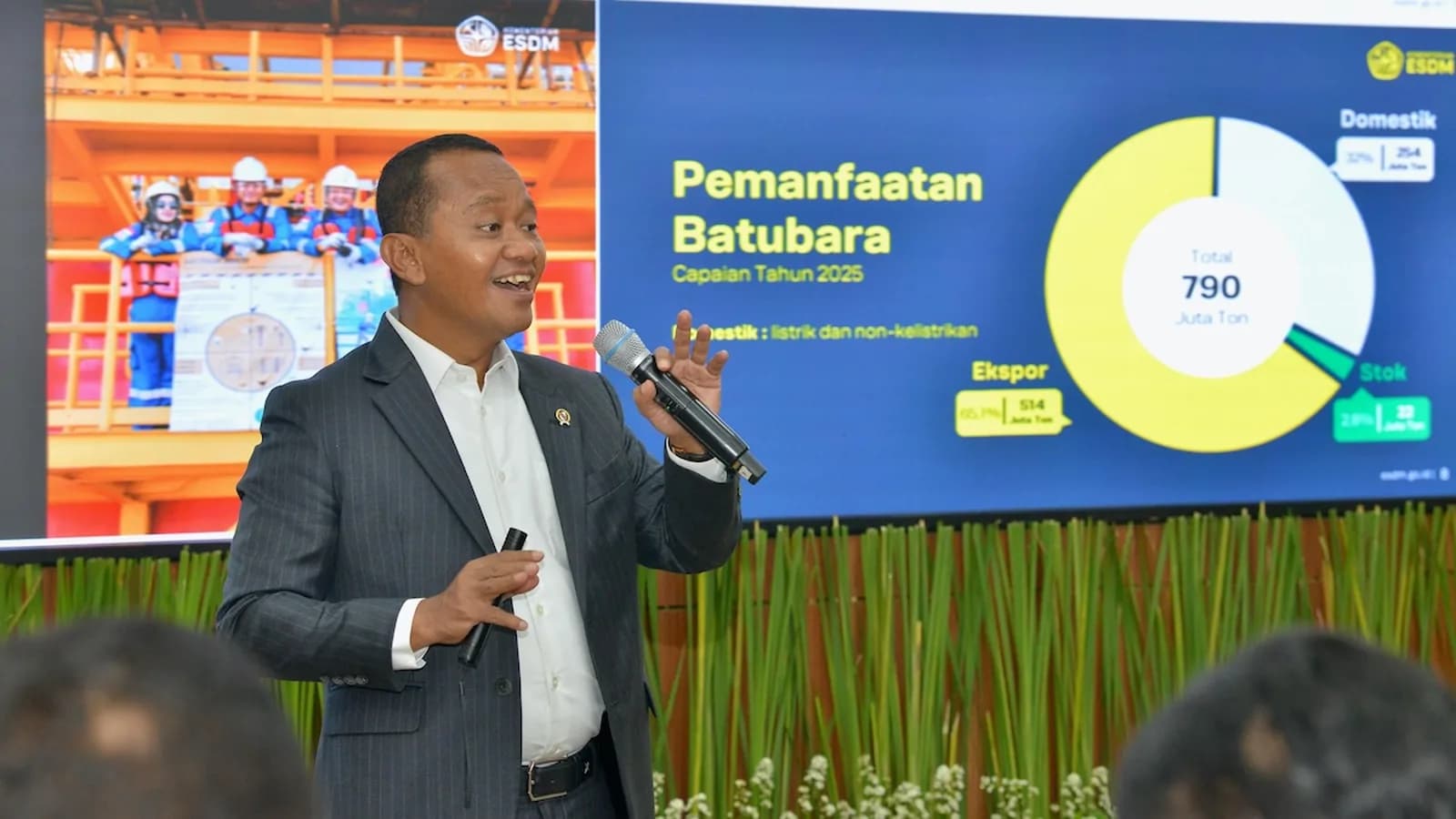
Both reshape a mine's economics, and both are policy variables that move. In 2025, the Ministry of Energy and Mineral Resources (ESDM) reports, domestic use took 32% of national coal output — 254 million tonnes — while 514 million tonnes went to export. In January 2026 the ministry said it would cut national production from 790 million tonnes in 2025 to about 600 million tonnes and recalculate each company's quota through the RKAB. This article explains the instrument, the floor, the cap, and how the ministry measures compliance — taken from the regulations and ministry releases themselves.
What the DMO is, in the regulation's words
The framework sits in Ministerial Regulation (Permen) ESDM No. 25 of 2018 on mineral and coal mining business, dated 30 April 2018. Article 32 states that the Minister controls mineral and coal sales in order to guarantee domestic supply, maintain economic resilience, safeguard defence and security, and control prices. To do so, the Minister sets two things: the quantity and type of mineral and coal required to meet domestic needs — the regulation names this the *domestic market obligation* — and the quantity and type that may be sold abroad.
That structure is the point. The state does not only request a share of the tonnage; under Article 36(1) the Minister also sets the domestic coal selling price "in accordance with the quality of the coal", and Article 36(2) requires that price to take the national interest into account. Volume and price are both administered.
The 25% floor, and who owes it
ESDM has applied a floor of 25% of planned production since at least 2018. A ministry release dated 20 January 2018 announced that the year's DMO was set at a minimum of 25% of the national production plan, through Ministerial Decision (Kepmen) ESDM No. 23K/30/MEM/2018.
A second release, on 12 March 2020, restated the rule for that year under Kepmen ESDM No. 261 K/30/MEM/2019: holders of an IUP Operasi Produksi for coal, an IUPK Operasi Produksi for coal, and a PKP2B at the operation stage must sell their coal for domestic needs at a minimum of 25% of their planned coal production.
In 2022 the ministry paired the same floor with a national quota. Minister Arifin Tasrif told a working meeting with Parliament's Commission VII that the 2022 DMO was 166 million tonnes out of a planned production of 663 million tonnes, applied to every PKP2B, IUP and IUPK holder at 25% of production.
Two features matter to a foreign reader. The obligation falls on the licence holder, and its denominator is planned production — the tonnage in the plan the ministry has approved — not last year's actual output. And 25% is a floor, not a ceiling: a holder may sell more domestically, and in 2025 the sector did, at 32%.
The price cap: US$70 a tonne for power
Coal sold into domestic electricity generation is not priced by the market. In the ministry's March 2020 release, the then Director General of Mineral and Coal, Bambang Gatot Ariyono, described the guarantee directly:
"Tidak ada masalah kita sekarang baru 25%, naik sampai 50% seandainya itupun tidak akan ada masalah, kita produksi empat kali lipat dari kebutuhan untuk DMO, mesti akan terpenuhi DMO. Tidak ada masalah, kita Pemerintah memastikan pro kepada publik kenapa? karena harga batubara untuk listrik dijamin tidak lebih dari USD 70." — Bambang Gatot Ariyono, Jakarta, 12 March 2020.
In English: there is no problem at 25% and none even if it rose to 50%, because national production is four times the DMO requirement — and the government guarantees that the coal price for electricity is no more than US$70.
The cap has held since. On 22 June 2026, The Jakarta Post reported that the state utility PLN was constrained by "a US$70 price cap that bars it from competing for supply", alongside regulatory ambiguity over where domestic coal flows and a compensation fund that remained in limbo. The same report quoted Ahmad Zuhdi Dwi Kusuma, an associate principal at the Energy Shift Institute, saying the government had made it impossible for PLN to pay market prices for coal.
How compliance is assessed against the RKAB
The 25% obligation is not policed as a standalone return. It is policed through the RKAB — the annual Work Plan and Budget an operation-stage holder must have approved before it may mine. The ministry has made the link explicit. In February 2022, Arifin Tasrif stated that the volume of coal supplied to PLN's own power plants by each mining company is written into the approved RKAB, "which companies must obey".
Where a holder sells short of its obligation, the stated sanction has hardened over time, but it has always run through the plan:
- In 2018 the ministry described the penalty as a cut to the production figure in the following year's RKAB, plus a reduction of the export quota by the amount of the unmet DMO.
- By 2022 the list had grown. Companies that fail to meet the DMO or a set sales contract face an export ban and a duty to pay a DMO fine or compensation, under guidelines in Kepmen ESDM No. 13 of 2022; Kepmen ESDM No. 139 of 2021 governs the domestic coal supply obligation itself.
In January 2026 the ministry approached the same mechanism from the other side. Announcing a plan to revise the 2026 RKAB to support prices, ESDM said the Directorate General of Mineral and Coal was calculating each mine's production quota in detail through the RKAB system, and that companies were expected to align their work plans with the new policy.
What it means for a miner and for an offtaker
This is where the DMO stops being paperwork and becomes an economic variable.
For the miner, the DMO is a slice of output that cannot chase the export price. When seaborne coal is strong, the gap between the export price and the capped domestic price is a direct opportunity cost on every tonne committed at home — the tension the ministry itself has acknowledged, and the one The Jakarta Post reported in 2026 as mines weighed the penalty against the export premium.
For the offtaker — chiefly PLN and the independent power producers that supply it — the cap is a guarantee of price but not of volume. A producer that can earn more abroad has an incentive to under-deliver the domestic quota, and the state's answer has been enforcement through the RKAB and the threat of an export ban rather than a market price. That trade-off sits behind the 2026 supply debate.
For the foreign investor, the practical reading is that the DMO is a floor on domestic exposure that is reset by policy each year, not a fixed contract term. The approved RKAB is where that floor is applied, and the government's annual production quota — now being cut — is the lever that moves it.
Timeline
| Date | Development |
|---|---|
| 20 Jan 2018 | ESDM sets the 2018 DMO at a minimum 25% of the national production plan (Kepmen 23K/30/MEM/2018); shortfall penalty is a cut to the next year's RKAB output and an export-quota reduction. |
| 30 Apr 2018 | Permen ESDM No. 25/2018 formalises the framework: the Minister sets the domestic-market quantity and the exportable quantity (Art. 32) and the domestic selling price by coal quality (Art. 36). |
| 12 Mar 2020 | Ministry restates the 25% floor for IUP OP, IUPK OP and PKP2B OP holders (Kepmen 261 K/30/MEM/2019); domestic need 155 Mt; guarantees coal for electricity at no more than US$70/tonne. |
| 17 Feb 2022 | 2022 DMO set at 166 Mt of a 663 Mt production plan at 25% for PKP2B, IUP and IUPK; sanctions become an export ban plus a DMO fine or compensation (Kepmen 13/2022). |
| 8 Jan 2026 | ESDM announces an RKAB 2026 revision; national production to be cut from 790 Mt (2025) to about 600 Mt; 2025 domestic use reported at 32%, or 254 Mt. |
| 22 Jun 2026 | The Jakarta Post reports PLN constrained by the US$70 cap amid a coal-supply and power crisis. |
Catatan Teramine
*This section is Teramine's editorial assessment, not a statement from any government body and not a recommendation.*
Three things are worth separating. First, the DMO is a quantity rule measured against a plan. Because the denominator is approved planned production, the ministry can raise the effective domestic share without touching the 25% number — simply by cutting the plan. That is the mechanism on display in 2026, when the government moved to reduce national output from 790 million tonnes to about 600 million while domestic demand stays broadly fixed. A lower national total with the same domestic need mechanically lifts the domestic share. An investor modelling 25% as a constant would miss that.
Second, the price cap, not the quota, is the weak point. A 25% floor is enforceable because the state controls the RKAB and the export gate; a US$70 cap is not, because it relies on producers accepting a discount to the export price. When that gap widens, supply leaks. The 2026 power disruption in Java is the clearest recent illustration, and it points to the real policy choice the government faces: raise the cap, or compensate producers through a fund. Both are on the table; neither is settled.
Third, for a buyer of Indonesian coal, the DMO is a supply risk, not only a price advantage. A capped domestic price looks attractive until the volumes do not arrive. The diligence question is not "what is the cap" but "which mine, under which approved RKAB, is contractually and economically able to keep feeding the domestic market when the export price doubles".
Where the question is transactional, the assets are listed on the [mining marketplace](/en/marketplace). Where it is permit or filing work against an existing licence — RKAB, IUP, IUJP — that sits with our [permit services](/en/layanan-izin). Background on the commodity and the wider policy is in our pieces on [coal mining in Indonesia](/en/news/coal-mining-in-indonesia), [what the RKAB is](/en/news/what-is-rkab-indonesia), [the mineral export ban](/en/news/indonesia-mineral-export-ban) and [mining royalties](/en/news/indonesia-mining-royalties).
What we could not verify
- The exact 2026 DMO quota in million tonnes from a primary document. We read the ministry's January 2026 statement about the RKAB revision and its 2025 realisation; we did not read the 2026 Kepmen that sets the annual figure.
- The precise percentage above 25% applied in 2026, and whether the government has formally raised the floor.
- The formula by which the US$70 cap scales with coal calorific value. The regulation gives the Minister power to price by quality; we did not read the pricing decision that sets the band.
- Per-company DMO compliance data, and the 2025 production split beyond ESDM's own summary figures.
- The status and terms of the compensation fund mentioned in the 2026 reporting.
Sources
Every figure and quotation above comes from the documents below, each opened and read for this article.
- Peraturan Menteri ESDM No. 25 Tahun 2018, dated 30 April 2018 (Berita Negara No. 595/2018) — Articles 32 and 36.
- ESDM press release, 20 January 2018, "Porsi DMO Batubara Tahun 2018 Ditargetkan 25%".
- ESDM press release, 12 March 2020, "Kebutuhan Batubara Untuk Kepentingan Dalam Negeri Dijamin Terpenuhi".
- ESDM press release, 17 February 2022, "Raker DPR, Menteri ESDM Sampaikan Patokan DMO 2022".
- ESDM press release, 8 January 2026, "Perbaiki Harga Batubara, Pemerintah Bakal Revisi RKAB Tahun 2026".
- The Jakarta Post, 22 June 2026, "Coal price gap triggers power crisis in Indonesia".