Explosives are the point at which an Indonesian mining permit turns from a right to dig into a set of safety duties that reach the magazine, the pattern and the person who pulls the trigger. On blasting, the rulebook is unusually specific: it fixes safe distances, caps how much explosive a magazine may hold, names the cards a blaster must carry, and requires a studied design behind every hole. And it does not sit apart from the licence — the blasting-safety duty is written into the operating regulation as a component of the permit obligation itself.
This explainer sets out what the rulebook requires of an IUP or IUPK holder: where the rules sit, why blasting safety is a permit duty rather than a site preference, how explosives must be stored and how far the magazine must sit from people and infrastructure, who may handle explosives and under what cards, what a blast design must be studied for, how the blast itself is run, and how a failure is enforced. Every figure, article and annex below is taken from the primary texts — the ministerial regulation and the implementing decree — read directly from the Ministry of Energy and Mineral Resources' legal database.
Where the rules sit
Explosives at a mine in Indonesia are governed inside the mining-safety chapter of good mining practice, not by a stand-alone explosives statute. The chain runs from the mining law through the ministerial regulation to the implementing decree:
| Instrument | Date | Its role here |
|---|---|---|
| Law No. 4 of 2009 on Mineral and Coal Mining | 2009 | the statutory basis the operating rules derive from |
| Ministerial Regulation (Permen) ESDM No. 26 of 2018 | 3 May 2018 (State Gazette 2018 No. 596) | the operative regulation: Article 14 requires IUP/IUPK holders to implement mining safety and lists explosives and blasting safety as a component of mining operational safety; Article 15 delegates the implementation guideline to the Minister |
| Ministerial Decree (Kepmen) ESDM No. 1827 K/30/MEM/2018 | 7 May 2018 | the guideline that fulfils that delegation — Annex III is the mining-safety guideline (its section A, item 6 is *Keselamatan Bahan Peledak dan Peledakan*), and the surface-mining part of Annex II carries the blast-design and drilling rules |
| Government Regulation (PP) No. 96 of 2021 | 9 September 2021 (State Gazette 2021 No. 208) | the government regulation implementing the mining law, under which mine safety is treated as an operating aspect |
Status matters. The state's legal database records Permen 26/2018 as not itself revoked or amended, and records Kepmen 1827/2018 as partially revoked by Kepmen ESDM No. 111.K/MB.01/MEM.B/2024 (21 May 2024) — but only as to a single provision, the one in Annex VI on reopening areas that have already been reclaimed. The explosives and blasting provisions in Annexes II and III are untouched.
Blasting safety is a permit duty, not a site preference
Article 14(1) of Permen 26/2018 requires every IUP Eksplorasi, IUPK Eksplorasi, IUP Operasi Produksi and IUPK Operasi Produksi holder to carry out mining safety. Article 14(3) splits that duty into occupational health and safety and mining operational safety, and Article 14(5) lists the components of operational safety — including, at point f, *keselamatan bahan peledak dan peledakan*, explosives and blasting safety, alongside the maintenance system, equipment fitness and competent technical personnel.
Two further paragraphs matter. Article 14(2) requires the holder to provide the equipment, protective gear, facilities, personnel and budget the safety duty needs, and to set up a safety organisation. Article 14(6) pins the whole duty to the project's own documents: it is carried out on the basis of the feasibility study, the environmental document and the approved annual work plan and budget (RKAB).
In plain terms, blasting safety at an Indonesian mine is a component of a permit obligation, and the document that shows how it is run is the RKAB.
Storing explosives: a licensed magazine, not a shed
Annex III, section A.6(a) treats where explosives are kept as a controlled facility. They must be stored in a warehouse — a building, container or tank — that is technically capable of storing them safely. On a mine, explosives may only be kept in a magazine whose capacity has been set in writing by the Chief Mine Inspector (KaIT), or the head of the provincial mining office acting for the KaIT. A magazine sited outside the licence area or project area needs that same written approval, as does a magazine used for purposes other than mining. The magazine must be built to construction drawings approved in the annual RKAB, with detailed technical requirements left to a technical guideline issued by the Director General of Mineral and Coal. The approval can be withdrawn if the magazine no longer meets the requirements — and if mining stops for more than three months, the mine manager (KTT/PTL) must report it and the magazine must still be guarded.
The guideline classifies magazines by function and by explosive type, with capacity ceilings for each. Temporary magazines serve the exploration, construction and pre-mining stages; main magazines sit near the mine; transit magazines hold explosives briefly inside the licence or project area. By type, it separates detonator-sensitive, primary-sensitive and blended (*ramuan*) materials. A representative set of the caps:
| Magazine | Explosive type | Building | Container | Tank |
|---|---|---|---|---|
| Temporary | Detonator-sensitive | ≤ 8,000 kg | ≤ 4,000 kg | — |
| Temporary | Primary-sensitive | ≤ 20,000 kg | ≤ 10,000 kg | — |
| Main | Detonator-sensitive | ≤ 150,000 kg | ≤ 4,000 kg | — |
| Main | Primary-sensitive | ≤ 500,000 kg | ≤ 10,000 kg | ≤ 100,000 kg |
| Main | Blended (*ramuan*) | ≤ 2,000,000 kg | ≤ 25,000 kg (storage area ≤ 1,000,000 kg) | ≤ 300,000 kg |
The storage rules are as strict as the caps. Detonators must never be stored in the same magazine as other explosives — they go in a dedicated magazine. Detonator-sensitive explosives must not be kept in a primary-sensitive or a blended magazine; primary-sensitive explosives may share with detonator-sensitive but not with blended; blended material may share with primary-sensitive and/or detonator-sensitive. Liquid or gel blended explosives may only go in a tank magazine.
Safe distances
Annex III, section A.6(b) sets the distances. A surface magazine's location must account for a safe distance from inhabited buildings, hospitals, other buildings and offices; from liquid-fuel storage, tanks, workshops and major public roads; from railways and minor public roads; and from other magazines according to their capacity. Underground magazines are given hard numbers, measured in a straight line:
- at least 100 metres from a mine shaft or another underground magazine;
- at least 25 metres from a workplace;
- at least 10 metres from a raise or winze used for people and transport; and
- at least 50 metres from the blasting location.
Inside, a magazine is arranged into a storage room and a receipt-and-dispatch room; receipt or dispatch of detonator-sensitive and primary-sensitive explosives takes place in the front room with the connecting door closed.
Who may handle explosives
The guideline names the people, not just the roles. Blasting work is done by a juru ledak — a blaster appointed by the company or the mine manager, responsible for carrying out the blast and holding a Kartu Izin Meledakkan (KIM), the blasting permit card. Supporting work is covered by two levels of Kartu Pekerja Peledakan (KPP):
- KPP Pertama covers securing the explosives and stemming the blast holes, and is issued after internal training run by the mine manager.
- KPP Madya covers moving detonator-sensitive explosives, detonators, primary-sensitive and blended material to the blast site, magazine administration, mixing, making primers, loading the holes and wiring the circuit; it follows blaster (class II) training run by the relevant agency.
- KIM covers testing the blast pattern, setting the danger area, clearing people to shelter, firing, handling misfires, connecting the blast circuit to the detonator circuit, controlling the blast's effects and confirming the result. A KIM may only be issued to a person who holds a blaster (class II) competency certificate and is at least 21 years old.
The KIM is bound to a place: it is valid only for the mine named on the card, and the blaster's name is entered in the mine's *Buku Tambang* (mine record book). If a KIM holder stops doing blasting work, the card is returned and exchanged for a KPP Madya. A competency certificate issued in or outside Indonesia may be recognised by the KaIT, after which it carries the same value. There is a currency rule too: a blaster who does not apply for a KIM within six months of certification, or whose KIM has been expired for a year or more, must sit and pass a refresher examination on the safe handling of explosives.
The magazine has its own responsible officers: a kepala gudang (magazine head) who must hold at least a KPP Madya and understand the explosives rules, and attendants aged 21 or over. The magazine must be guarded continuously, 24 hours a day; only authorised people, the Mine Inspector and the police who deal with explosives may enter, and explosives may only be handled by the blaster and the magazine officers. The magazine keeps a logbook and an inventory list, archived for at least a year, and the mine manager reports stock and usage to the KaIT quarterly. The contents are checked thoroughly at least once a week.
Behind the blast design
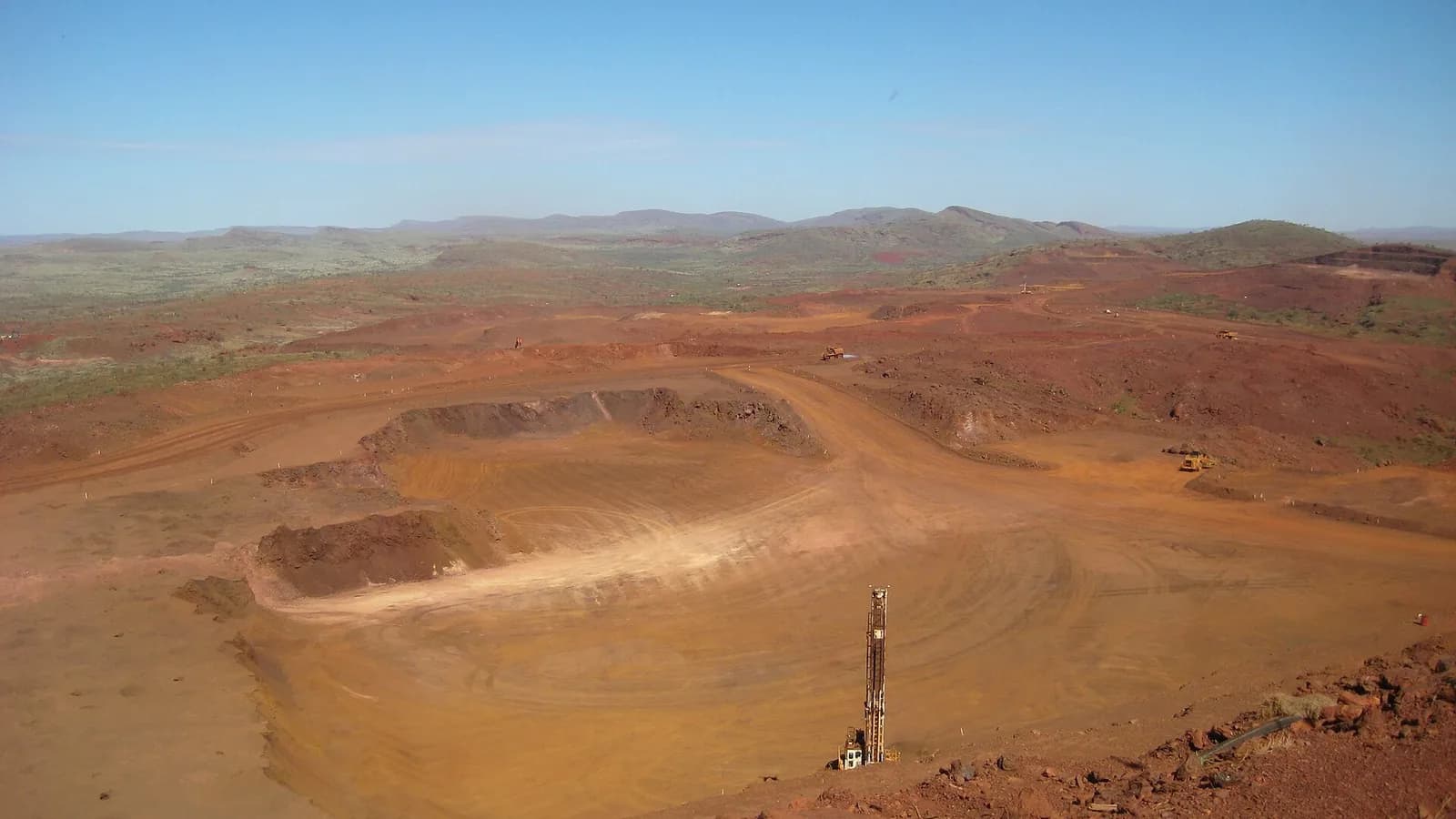
The surface-mining part of Annex II makes the blast design a documented, studied exercise. Where overburden is broken by drilling and blasting, the technical study must at least cover: the production rate; the physical and mechanical properties of the rock; groundwater; geology; the velocity of detonation; electrical hazard; fragmentation; flyrock; ground vibration; air blast; rock anomalies — reactive ground, hot ground, methane and toxic gas — and a risk analysis. The blast-hole geometry and pattern are set by competent technical mining personnel, and the guideline fixes some parameters:
- the stiffness ratio (blast-hole depth to burden) must be at least 2 and at most 4;
- blast holes in overburden must not touch the coal seam, with at least 0.5 metres between the hole and the seam, unless a technical study determines otherwise;
- a berm at least one-third the wheel height of the largest haul unit must be built at one burden's distance from the outermost hole;
- the ground-vibration acceleration, frequency and particle velocity produced must not exceed the value used in the slope safety-factor calculation;
- any change to the blast geometry, the explosive type, the safe distance, the vibration level or the method requires a technical study first;
- the safe distance from the outermost blast boundary is 300 metres for equipment and mining facilities and 500 metres for people, measured horizontally, or as a technical study determines; and
- blasting within a horizontal 500 metres of a railway, power line, dam or other public building requires a technical study.
Open-pit blast vibration against buildings follows SNI 7571:2010 and its amendments. Blasting where the rock is hotter than 55°C, where methane exceeds 50% of the lower explosive limit, or where the ground is reactive must also be studied — the study covering the explosive's type and properties, how the hole is made safe to load, and how long the explosive may stay in the hole. Mining within less than five times the burden of an area that has been loaded, or that holds a misfired hole, is prohibited; the oxygen balance of a primary-sensitive explosive must sit between 5.5% and 6.5% for the fuel oil in ANFO; and blasting under water must not disturb marine life. A rock-breakage technical study is sent to the Head of the Mine Inspectorate as a special report.
How the blast itself is run
Annex III, section A.6(d) to (k) sequences the operation. For drilling for blasting, the mine manager appoints operational and technical supervisors, must establish that the drill rigs have passed a fitness test, and must confirm the work follows the set procedure. Blasting equipment must be available and approved by the mine manager, and every blasting machine must carry safety systems — a crank, a key, a clamp tip or shotshell primer, a safety lock and a code for electronic detonators — without which it cannot be used.
The blast is carried out by the blaster, who ensures each stage is done safely and that the blast does not push environmental effects beyond the set thresholds. Remote firing is allowed only with a technical recommendation from the agency that handles communication and information, under procedures set by the mine manager, and may only be fired by a blaster trained for it. The safe radius around a blast is set and owned by the mine manager, on a technical calculation and risk assessment, covering at least people, equipment, mining facilities and the environment. Blasting that carries more risk than normal — vibration and airblast control, reactive ground, hot holes, methane, or secondary blasting — is handled as special blasting with additional controls.
A sleep blast (*peledakan tidur*) may not use a surface detonator on the hole, the area must be secured, and an unplanned one must be reported to the KaIT. After a blast, the blaster inspects the site once the dust and smoke have cleared, and no one may enter before the blaster declares it safe. A misfire (*peledakan mangkir*) — a circuit that cannot be repaired, or a hole that fails to fire — is reported to the operational supervisor, who bars entry, determines the cause, handles it, and posts guards against theft of explosives or detonators; if it cannot be cleared the same day, it is treated as a sleep blast.
How it is enforced
The enforcement chain is direct. Under Article 45 of Permen 26/2018 the Minister and governors supervise the carrying-out of good mining practice, through the Mine Inspector (Inspektur Tambang) — by evaluating periodic and special reports, by periodic or ad-hoc inspection, and by assessing the success of programmes. Under Article 46 the Mine Inspector may enter a mining site at any time and temporarily suspend part or all of the operation where it is judged to endanger worker or public safety or to cause pollution or environmental damage.
A breach of the Article 14 safety duty is caught by the sanctions article. Article 50(1) lists the provisions whose breach attracts administrative sanctions, and Article 14(1), (2) and (6) are among them. Article 50(8) sets the sanction types — a written warning, temporary suspension of part or all of the business activity, and/or revocation of the permit — and Articles 51 to 53 set the clock: a written warning at most three times, each for a maximum of 30 calendar days; then temporary suspension for up to 60 calendar days; then revocation if the obligation is still unmet.
What it means for a foreign investor
- Blasting is a licence item. The duty to run explosives and blasting safely is written into the same regulation that carries the permit obligation, and failing the safety duty is a listed ground for suspension or revocation.
- The magazine is a permitting artefact. Capacity, siting and drawings sit with the mine inspectorate and the annual RKAB; a project that treats the magazine as a construction detail rather than a permitted facility has the sequence backwards.
- The blaster's card is bound to the mine. A KIM is valid only for the named mine; bringing in a blaster means matching the card, the competency certificate and the *Buku Tambang* entry.
- The design is documented. Stiffness ratio, safe distances and the vibration standard are not judgement calls but stated parameters, and a technical study is required before a change and for blasts near railways, power lines, dams and public buildings.
- Diligence should read the two files that carry this. The approved RKAB (which the safety duty is anchored to, Article 14(6)) and the magazine approval — plus the technical studies for rock breakage, which are reported to the Head of the Mine Inspectorate.
Catatan Teramine
*This section is Teramine's editorial assessment, not a statement from any government body and not a recommendation.*
Read together, the explosives and blasting rules describe a documented-control framework rather than a list of banned acts. The decree does not simply forbid unsafe blasting; it requires the holder to hold a licensed magazine, to keep a study behind the design, to name a carded blaster, to set and own a safe radius, and to have a procedure for the misfire and the sleep blast. That is why a diligence file on an operating mine is, in practice, a paper check as much as an engineering one: the magazine approval, the blaster's KIM, the rock-breakage study and the RKAB should exist and agree with each other.
The second observation is currency. The operative guideline is from 2018, and it delegates several technical details — magazine construction, storage procedure, explosives transport — to a Director General's technical guideline that we did not read. A project relying on these duties should confirm the current technical guideline before it files, rather than assume the 2018 annex is the last word. And the decree's own status is worth checking: it is partially revoked as to one Annex VI provision, so a reader should confirm the text in force rather than assume the 2018 wording is unchanged everywhere.
What we could not verify
- Any enforcement statistics specific to blasting or explosives. We read the sanction articles; we did not find or read data on how often the suspension or revocation powers have been used for a blasting-safety or explosives-storage breach.
- The Director General's technical guidelines. The decree refers repeatedly to a *petunjuk teknis* issued by the Director General for magazine construction, storage procedure and the transport of explosives; those guidelines were not read.
- The explosives-licence side outside this decree. The national regime for the manufacture, sale and police-side licensing of explosives is outside the mining decree and outside the scope of this article; no claim about it is made here.
- Any named company, project or production figure. This article describes rules; it names no operating company and reports no blast, reserve or output figure.
Sources
Every rule, figure and date below comes from an official text read in full or in the relevant part, downloaded from the legal information database of Indonesia's Ministry of Energy and Mineral Resources (JDIH ESDM).
- Peraturan Menteri ESDM No. 26 of 2018 on the Implementation of Good Mining Practice and Supervision of Mineral and Coal Mining, dated 3 May 2018 (State Gazette 2018 No. 596) — read for Article 3 (good mining practice as a permit obligation), Article 14 (the mining-safety duty of IUP/IUPK holders: the obligation to implement safety at paragraph 1; the equipment, personnel and budget at paragraph 2; the split into occupational health and safety and mining operational safety at paragraph 3; the components of operational safety at paragraph 5, including point f on explosives and blasting safety; and the anchoring to the feasibility study, environmental document and approved RKAB at paragraph 6), Article 15 (delegation of the safety guideline to the Minister), Article 45 (supervision by the Minister and governors through the Mine Inspector), Article 46 (the Mine Inspector's right of entry and power to suspend), and Articles 50 to 53 (administrative sanctions, the listing of Article 14(1), (2) and (6) among the sanctionable breaches, and the 30-day and 60-day limits).
- Keputusan Menteri ESDM No. 1827 K/30/MEM/2018 on Guidelines for the Implementation of Good Mining Practice, dated 7 May 2018 (370 pages) — read for Annex III (the mining-safety guideline, *Pedoman Pelaksanaan Keselamatan Pertambangan dan Keselamatan Pengolahan dan/atau Pemurnian Mineral dan Batubara*), section A, item 6 (*Keselamatan Bahan Peledak dan Peledakan*): the storage and magazine rules including capacity classification and the written approval of the Chief Mine Inspector; the surface and underground safe distances; the *juru ledak* and the KPP Pertama, KPP Madya and KIM cards; the magazine head and attendants; the 24-hour guarding, logbook, weekly inspection and quarterly reporting; the receipt and dispatch rules; the transport-of-explosives rules; the drilling, blasting-equipment and blast-operation rules; remote firing; the safe-radius duty on the mine manager; special blasting; the sleep blast; and the post-blast and misfire procedure. Read also for the surface-mining part of Annex II on rock breakage: the required contents of the drilling-and-blasting technical study, the stiffness ratio, the coal-seam clearance, the berm, the vibration limit tied to the slope safety factor, the 300-metre and 500-metre safe distances, the study trigger near railways, power lines and dams, the SNI 7571:2010 vibration standard, the hot-ground and methane study, the five-burden prohibition, the ANFO oxygen-balance range, the submarine-blasting rule, and the special report to the Head of the Mine Inspectorate.
- Keputusan Menteri ESDM No. 111.K/MB.01/MEM.B/2024, dated 21 May 2024 — read for the partial revocation it makes to Kepmen 1827/2018, limited to the provision on reopening areas that have already been reclaimed (Annex VI, section D.4.b.2).
- Peraturan Pemerintah No. 96 of 2021 on the Implementation of Mineral and Coal Mining Business, dated 9 September 2021 (State Gazette 2021 No. 208) — the government-regulation framework under which mine safety is treated as an operating aspect. Read at framework level; the amending texts were not read article by article for this article.
For the permit, document and compliance work behind this framework — the RKAB package, the technical studies and the reporting — see our [permit services](/en/layanan-izin) page. Mining assets currently listed are on the [mining marketplace](/en/marketplace).
Read this alongside the wider safety system an IUP holder must run, [Indonesia mining safety management system](/en/news/indonesia-mining-safety-management-system); the officers and competency certificates that sit above the blaster, [mining labour and certification in Indonesia](/en/news/mining-labour-certification-indonesia); the licence framework it sits inside, [Indonesia mining law](/en/news/indonesia-mining-law); and the wider screening question, [Indonesia mining investment climate](/en/news/indonesia-mining-investment-climate).