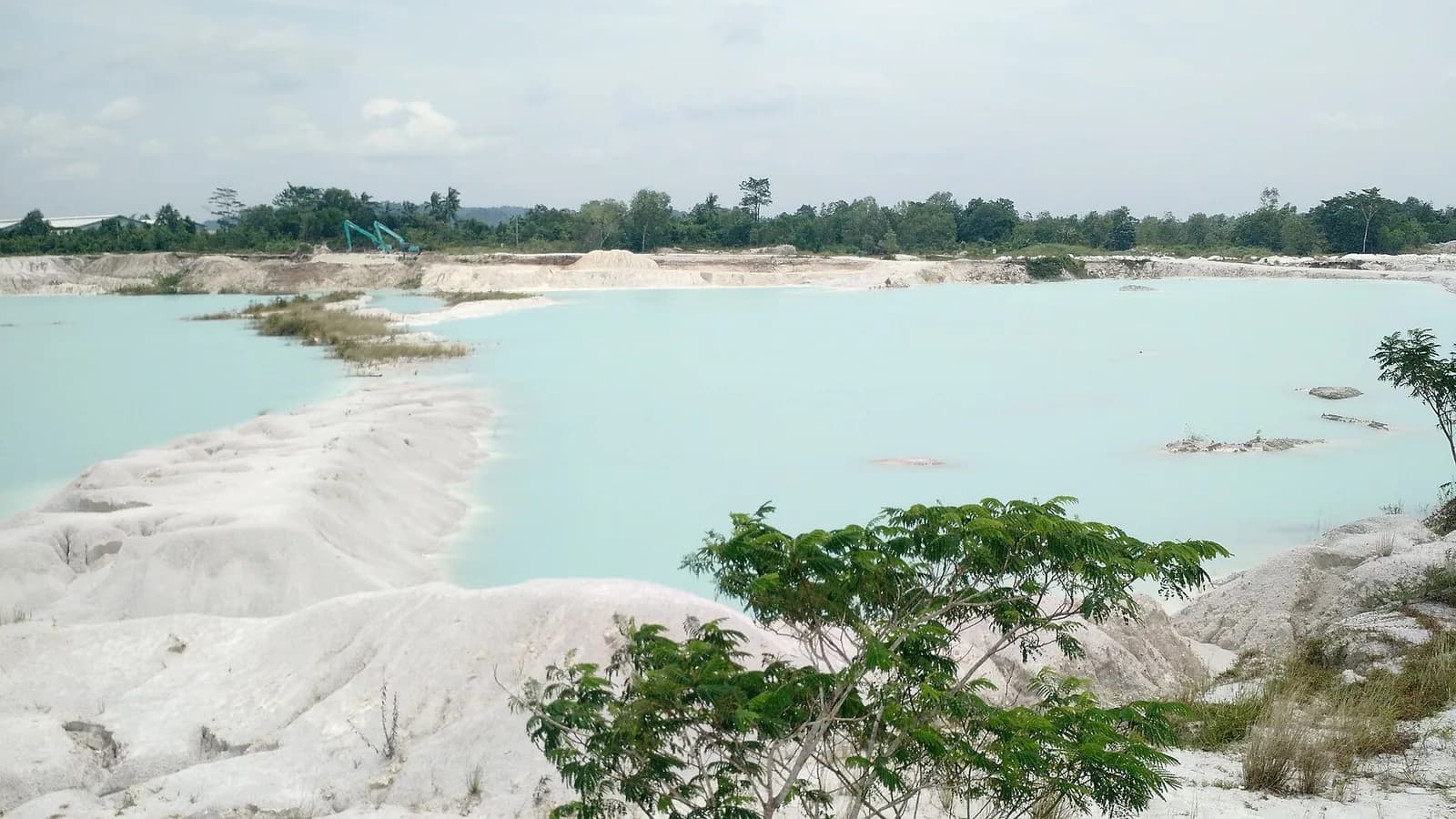
Indonesia's mining rules do not treat closure as a decision a company makes when the ore runs out. Reclamation is defined by regulation as an activity carried out throughout the stages of the mining business, and the state holds a cash guarantee against it. The liability is measured in hectares, priced by province and by year, and released only when a post-mining success test is satisfied in full.
Two obligations, not one
The technical rulebook is Keputusan Menteri ESDM No. 344.K/MB.01/MEM.B/2025, dated 23 October 2025 — the national technical guideline for *reklamasi* (reclamation) and *pascatambang* (post-mining) in mineral and coal mining, covering both land and marine workings.
It defines the two terms separately, and the difference matters:
- Reklamasi — activities carried out throughout the stages of the mining business to arrange, restore and improve the quality of the environment and the ecosystem so that it can function again according to its designation.
- Pascatambang — planned, systematic and continuing activities after the end of part or all of the mining business, to restore the natural environment's function and the social function according to local conditions, across the whole mining area.
Reclamation runs while the mine runs. Post-mining begins afterwards and is not a formality: it is a programme that continues until measurable success criteria are met.
Each obligation has its own ring-fenced fund. The guideline defines Jaminan Reklamasi and Jaminan Pascatambang as money provided by the IUP or IUPK holder as a guarantee for performing the corresponding work.
What the guideline covers
On the Ministry's own abstract of the regulation, Kepmen 344/2025 sets a single national standard for preparing, submitting, evaluating, approving, implementing and reporting the reclamation and post-mining plan documents; for amending a plan; for setting the size of the guarantee; and for disbursing it. It spans the exploration, operating-production and post-mining stages, and requires the plan documents to follow the approved feasibility study and environmental approvals. The plan itself must contain a land-clearing plan, a land-use arrangement, revegetation, civil works, programmes of other forms of reclamation, and measurable success criteria.
The Director General of Mineral and Coal holds the delegated authority to evaluate plans, determine guarantees, appoint third parties and apply administrative sanctions.
The guarantee: a time deposit held in the state's name
The mechanics sit in the guideline's annex. Read from the document, they work like this:
| Stage | Amount and timing | Form and term |
|---|---|---|
| Exploration | Placed in full at the outset, computed from the reclamation cost | Time deposit at a state bank in Indonesia in the name of the Director General or governor on behalf of the holder; 12-month term with automatic rollover |
| Operating production, first 5-year period | Placed in full for five years, no later than 20 working days after the plan is approved | As above, with the term following the reclamation schedule |
| Operating production, later periods | Either in full for five years, or annually, no later than 20 working days after approval or from the start of the year | As above |
Two details in that section deserve a second reading. Placing the guarantee does not remove the obligation to actually carry out the reclamation — and if the cost of completing it exceeds the amount held, the shortfall remains the holder's liability.
How the number is built
The per-hectare standard is not a flat national figure. Under Matrik 1 of the guideline's cost annex it is set per province and per year, and it escalates. Figures below are millions of rupiah per hectare, as printed in the regulation:
| Province | 2025 | 2026 | 2030 |
|---|---|---|---|
| Aceh | 147.1 | 155.9 | 196.9 |
| Kepulauan Riau | 117.8 | 124.9 | 157.6 |
| Sumatera Selatan | 185.5 | 196.6 | 248.2 |
| Nusa Tenggara Barat | 185.5 | 196.6 | 248.2 |
| Kalimantan Timur | 153.5 | 162.7 | 205.4 |
| Sulawesi Barat | 199.3 | 211.3 | 266.7 |
For the 2026 assessment year that is Rp162.7 million per hectare in East Kalimantan and Rp211.3 million per hectare in West Sulawesi. The complete matrix runs across the provinces and out to 2030.
The standard is assembled from direct costs — land arrangement, revegetation, and the prevention and control of acid mine drainage — and indirect costs: mobilisation and demobilisation of equipment, reclamation planning, the administering third party's overhead and profit, and supervision. Future value is applied at the last year of the period being proposed, using the yield on Government bonds for rupiah amounts and on US dollar bonds for dollar amounts. It is explicitly sized to cover the full cost of reclamation including where a third party performs the work. And for the first five-year period, it is calculated over the land the holder plans to open in those five years, not over ground already disturbed.
100 per cent, or you keep paying
Success is not self-declared. The guideline requires revegetated land to be maintained until the reclamation success criterion of 100 per cent is reached. On the post-mining side, where evaluation of the reports and a field assessment come in below 100 per cent after the post-mining period has ended, the holder may apply for an extension — which the Director General or governor can approve for no more than three years from the end of post-mining. No remaining post-mining guarantee may be released during that extension, and release requires a 100 per cent assessment.
If the holder still does not perform, the state substitutes itself. The guideline provides for the Director General or governor to appoint a third party, through a tender process, to carry out the reclamation and/or post-mining, funded from the guarantee. Bidders must hold an IUJP in reclamation and/or post-mining and have at least three years' experience; the winner must submit audited financial statements and a written commitment to complete the work to 100 per cent.
The obligation follows the ground
Three provisions elsewhere in the mining regulations show that this liability attaches to the area and the permit rather than to the calendar.
- Giving ground back does not retire it. Under Article 146 of Government Regulation No. 96/2021, a holder applying to reduce or return all of its WIUP or WIUPK must submit the reclamation and/or post-mining report for that area — and must first carry out the reclamation and/or post-mining to 100 per cent success on the ground being given up.
- It survives a change of instrument. Article 118 covers contract-of-work and coal-cooperation holders moving into a continuation IUPK: areas not accommodated in the approved full-area development plan must still be reclaimed and/or post-mined, to 100 per cent success, during the continuation permit, with the guarantee placement rules satisfied.
- It gates the stockpile. Article 183, as amended by Government Regulation No. 25/2024, deals with mineral or coal sitting in the stockpile facilities of a permit that has expired or been revoked. The Minister's field evaluation before approval covers the approved RKAB, the approved reclamation and post-mining plan together with the guarantee already placed, and production and sales reports.
On ground that can be mined again, the guarantee can come back: the guideline provides that where an area meets the criteria to be worked again, the Director General disburses the post-mining guarantee placed by the former holder once a new IUP or IUPK is issued over it.
What the state says is actually being reclaimed
The Directorate General of Mineral and Coal publishes its own reclamation realisation. From its performance report for 2025:
| Year | Target (ha) | Realisation (ha) |
|---|---|---|
| 2021 | 7,025 | 9,344 |
| 2022 | 7,050 | 11,084 |
| 2023 | 7,075 | 13,754 |
| 2024 | 7,100 | 26,538 |
| 2025 | 7,100 | 16,931 |
The report states the 2025 figure precisely: 16,930.74 hectares, or 238.46 per cent of the 2025 performance-agreement target of 7,100 hectares, and 169 per cent of the 10,000-hectare target in the directorate's strategic plan.
It also explains where the growth came from, and the explanation is not mainly more topsoil being moved. The additional area, the report says, is because data collection has become digital and because the Director of Technical and Environment, in his capacity as Chief Mine Inspector, issued a circular on improving periodic reporting of land clearing and reclamation. It names the reporting platform — PELITA, *Pelaporan Reklamasi dan Lingkungan Tambang*, socialised from 2024 — and records as a challenge that not all companies report digitally.
An earlier ministry release makes the enforcement point in plain terms:
FAKTA"UU Minerba baru memberikan sanksi tegas, termasuk sanksi pidana bagi pelaku usaha yang tidak melaksanakan reklamasi." — Bambang Suswanto, then acting Director General of Mineral and Coal, at the 2023 performance briefing in Jakarta, 16 January 2024. Translation: the new Mining Law provides firm sanctions, including criminal sanctions, for businesses that do not carry out reclamation.
What this means if you are buying
Read as a diligence list, everything above narrows to four questions a seller can document:
- Is there an approved reclamation and post-mining plan, and does it line up with the current feasibility study and environmental approvals? The rest keys off it — see our explainer on [IUP vs IUPK](/en/news/iup-vs-iupk) for how the permit instrument frames the holder's position.
- Is the guarantee placed, complete and current? It should be a time deposit in the state's name, sized against the provincial standard for the land the holder plans to open — and that standard rises every year.
- What has been opened, and what has been closed to 100 per cent? Because relinquished ground must be finished to 100 per cent first, a permit with pending relinquishments carries unfinished work.
- Where does the guarantee end up? Release requires a 100 per cent assessment, or, on re-mineable ground, comes to the former holder once a new permit is issued. Both are questions about who is holding what under the block you are buying.
Our [buying guide](/en/news/how-to-buy-a-mine-in-indonesia) sets out the wider deal process, and the [RKAB explainer](/en/news/what-is-rkab-indonesia) covers the annual plan the reclamation documents must sit inside.
Catatan Teramine
*This section is Teramine's editorial assessment, not a statement of fact from any source.*
Two things stand out. The first is that the ministry's own account of its headline reclamation figure is a reporting story, not an environmental one: digital collection plus a compliance circular took the number from 13,754 hectares in 2023 to 26,538 in 2024 and 16,931 in 2025, while the annual target barely moved. A figure that responds that strongly to how it is counted should be read as a measure of reported work rather than of restored land.
The second is that the guarantee is built to compound. Because the per-hectare standard is indexed to rise each year and is applied to planned land clearing rather than to past disturbance, the liability a buyer inherits on an unopened block is larger than the one that would have been assessed five years ago. In our reading, that design — not the sanction provisions — is where the regime's commercial teeth are.
For us the practical consequence is simple: in Indonesian mining transactions the reclamation file is not an annex. It is a quantified, escalating liability with a named beneficiary, a defined end point, and a state-appointed contractor waiting behind it.
What we could not verify
- The complete cost matrix. We read the guideline's Matrik 1 rows through the first 23 provinces; the table continues, so we have stated figures only for provinces we read.
- Why two official 2023 figures do not match. A Ministry press release of 18 January 2024 reported 7,920.77 hectares of reclamation realised in 2023; the 2025 performance report's table shows 13,754 hectares for the same year. Neither document explains the difference and we could not reconcile it.
- Any national total of guarantees held by the state. We did not include one, having read no official figure for it.
- Whether Kepmen 344/2025 has been amended since it took effect, or whether any province's standard has moved outside Matrik 1.
- Company-level compliance. Every figure here is national or per-province; nothing in this article is a statement about any named company.
Sources
The text of Kepmen ESDM 344.K/MB.01/MEM.B/2025, Government Regulation No. 96/2021 and Government Regulation No. 25/2024 was read from the official JDIH Kementerian ESDM copies. Reclamation realisation figures are from the Directorate General of Mineral and Coal's performance report for 2025 and from a Ministry press release of 18 January 2024. This article carries no figure, quotation or company name that is not in one of those documents.
For permit and document work, see our [permit services](/en/layanan-izin) page; for mining assets currently listed, see the [mining marketplace](/en/marketplace).