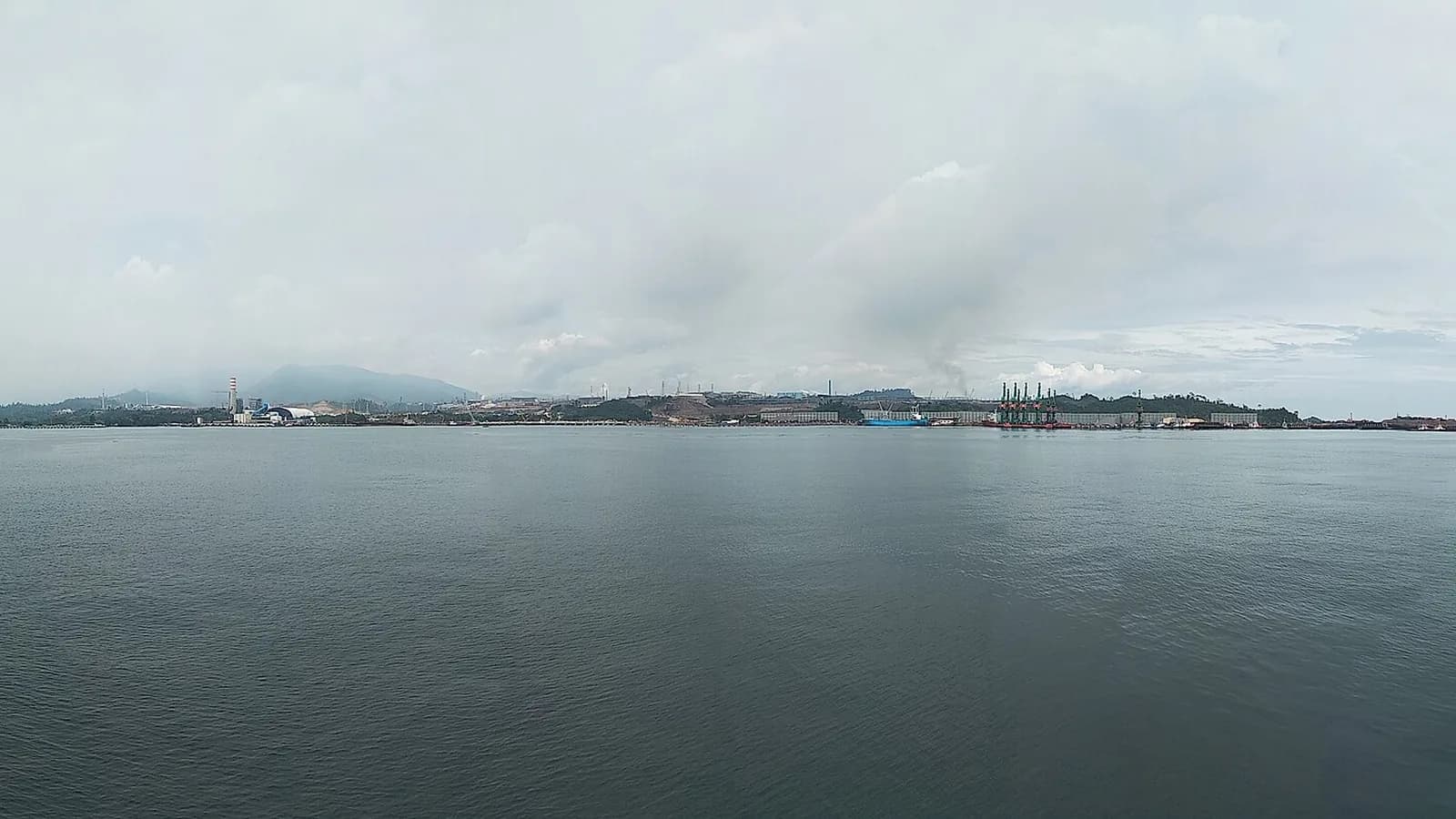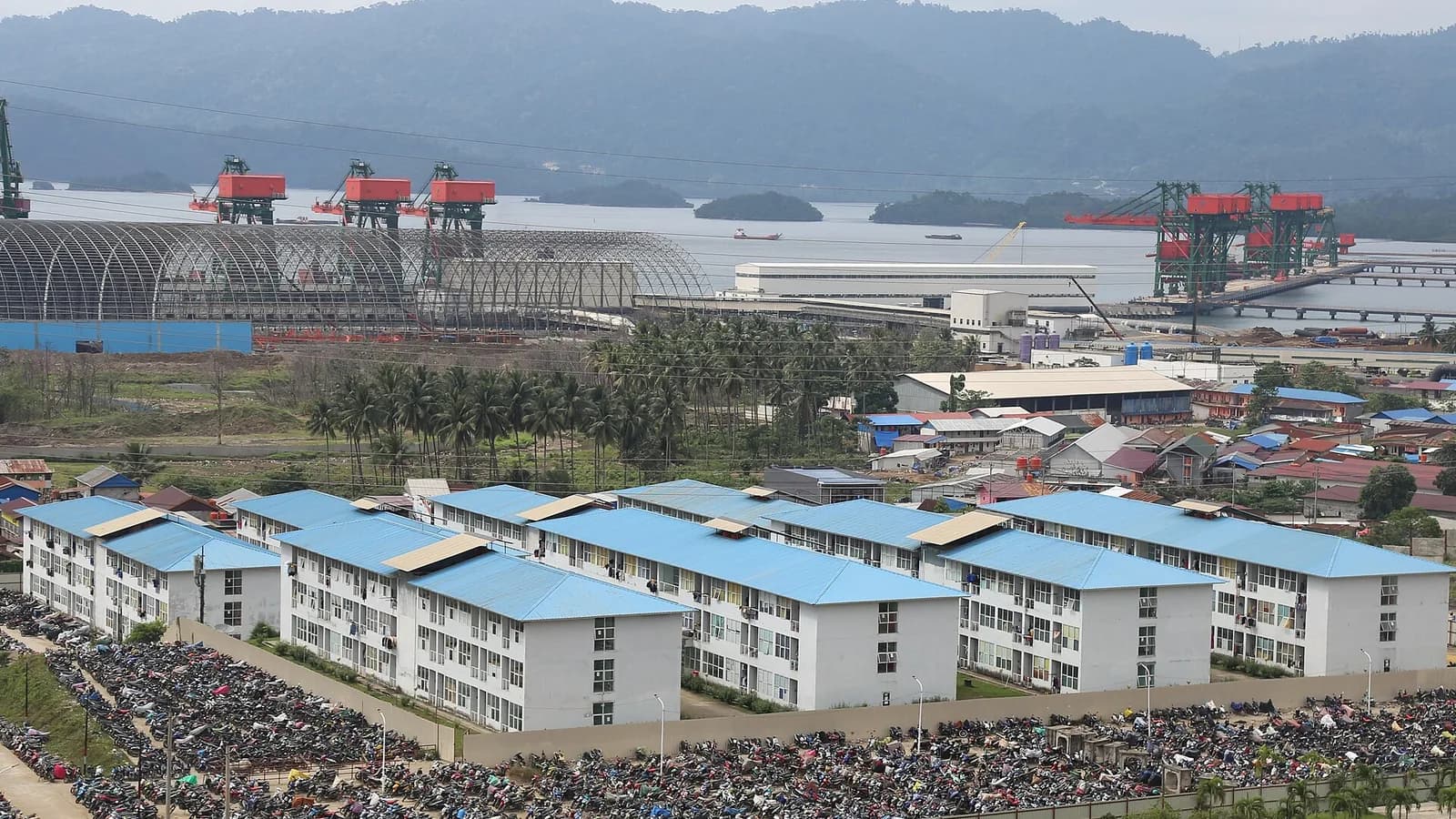
Indonesia's nickel sector is usually told as two stories: what the country mines, and what it forbids. The plant in between — the smelters and leaching works that turn ore into something that can leave the country — is less often set out in numbers, and it is the part that decides what Indonesia can actually make.
This article assembles that industrial footprint from the U.S. Geological Survey's Indonesia chapter of the *Minerals Yearbook* for 2023, including its production table and its structure-of-the-industry table, and from the *Mineral Commodity Summaries* papers for nickel and cobalt issued in February 2026. For the ore-side figure and for the ministry's own count of mine-integrated smelters, two CNBC Indonesia reports of 16 January 2024 carrying the Directorate General of Mineral and Coal's 2023 performance data are used, and are attributed as such. Where a figure is USGS's own estimate, it is marked as one. Nothing below is estimated by Teramine.
Two routes, two product families
USGS divides the fleet in two, and the division is not administrative — the routes use different ore and make different things.
Class II smelters are pyrometallurgical. They consume saprolite, the higher-grade nickel ore, and produce ferronickel and nickel pig iron (NPI). Both feed stainless steel.
Class I plants are hydrometallurgical, using the high-pressure acid leaching (HPAL) process on limonite, the low-grade ore. They produce mixed hydroxide precipitate (MHP) and, from it, nickel sulfate — the intermediate products that feed battery cathodes.
| Class II — pyrometallurgical | Class I — hydrometallurgical (HPAL) | |
|---|---|---|
| Ore feed | Saprolite (higher grade) | Limonite (low grade) |
| Plants in operation, 2023 | 44 | 3 |
| Ore consumed | 210 million tonnes a year | Almost 24 million tonnes a year |
| Products | Ferronickel, nickel pig iron (NPI); nickel matte (separate smelters) | Mixed hydroxide precipitate (MHP), nickel sulfate |
| Cobalt recovered as | Matte | MHP |
| Under construction, 2023 | 25 | 6 |
| In planning, 2023 | 28 | 10 |
| Ore those would require | An additional 200 million tonnes a year of saprolite | A total of 80 million tonnes a year of limonite |
Source: USGS, *Minerals Yearbook* 2023, Indonesia chapter.
The asymmetry is the point of the table. Forty-four plants making stainless-steel feed against three making battery feed; 210 million tonnes of ore appetite against 24 million.
What the fleet produced
Production figures, in tonnes of nickel content, from USGS's production table for Indonesia. *e* means estimated, *r* revised.
| Product | 2019 | 2020 | 2021 | 2022 | 2023 |
|---|---|---|---|---|---|
| Mined nickel (laterite ore) | 853,000 | 767,000 | 1,069,000 | 1,579,000 | 2,030,000 |
| Nickel pig iron | 380,000 | 600,000 | 850,000 | 1,100,000 | 1,390,000 |
| Nickel matte | 71,025 | 72,237 | 100,000 e | 210,000 r, e | 265,000 e |
| Mixed hydroxide precipitate | — | — | — | 90,000 r, e | 180,000 e |
| Ferronickel | 25,713 | 25,970 | 25,818 | 24,334 | 21,473 |
Three things in that table matter for anyone reading capacity rather than headlines.
NPI is the volume. It reached 1,390,000 tonnes of nickel content in 2023, roughly eight times the 180,000 tonnes in MHP, and USGS records its gross weight rising an estimated 22 percent to 9.9 million tonnes that year, from 8.1 million tonnes in 2022, attributing the increase to capacities added under the government's downstream programme.
Ferronickel is the shrinking line. Its nickel content has fallen every year since 2020, to 21,473 tonnes, and its gross weight to 110,000 tonnes from 122,000. The product Indonesia's older smelter fleet was built around is being displaced by NPI.
Matte and MHP are the fast-growing pair. Matte, the product of PT Vale's Sorowako smelter and of newer plants at Weda Bay and Morowali, more than tripled from 71,025 tonnes in 2019. MHP went from nothing in 2021 to 180,000 tonnes of nickel content in 2023, which is the HPAL route arriving.
Where the plants are, and who owns them
USGS's structure table lists the major facilities with an estimated annual capacity in thousand tonnes. The largest ferronickel and NPI smelters:
| Operator (equity as recorded by USGS) | Site | Capacity (thousand tonnes a year) |
|---|---|---|
| PT Tsingshan Steel Indonesia | Morowali, Central Sulawesi | 2,300 |
| PT Weda Bay Nickel (Tsingshan 51.3%, Eramet 38.7%, PT Antam 10%) | Central Halmahera, North Maluku | 2,300 |
| PT Obsidian Stainless Steel (Xiangyu Group and Jiangsu Delong Nickel Industry) | Morosi, Konawe, Southeast Sulawesi | 2,000 |
| PT Gunbuster Nickel Indonesia (Jiangsu Delong Nickel Industry 100%) | North Morowali, Central Sulawesi | 1,800 |
| PT Virtue Dragon Nickel Industry (Jiangsu Delong Nickel Industry 100%) | Morosi, Konawe, Southeast Sulawesi | 820 |
| PT Halmahera Jaya Feronikel (Harita Group 100%) | Obi Island, South Halmahera | 780 |
| PT Huadi Nickel-Alloy Indonesia | Bantaeng, South Sulawesi | 350 |
| PT Hengjaya Nickel Industry and PT Ranger Nickel Industry (Nickel Industries 80%) | Morowali, Central Sulawesi | 300 |
| PT Sulawesi Mining Investment | Morowali, Central Sulawesi | 250 |
| PT Megah Surya Pertiwi (Harita Group 60%) | Obi Island, South Halmahera | 240 |
| PT Wanatiara Persada | Obi Island, South Halmahera | 200 |
| PT Antam (MIND ID 65%, public 35%) | Pomalaa, Southeast Sulawesi | 120 |
| PT Century Metalindo | Pomalaa, Southeast Sulawesi | 50 |
USGS records six further ferronickel or NPI smelters without a published capacity figure: PT Central Omega Resources (North Morowali), PT Fajar Bhakti Lintas Nusantara (Central Halmahera), PT Gebe Industry Nickel (Gresik, East Java), PT Growth Java Industry, formerly PT Indoferro (Cilegon, Banten), and PT Indonesia Guan Ching Nickel and Stainless Steel (Morowali).
Nickel in matte, in tonnes of nickel content: PT Vale Indonesia, Sorowako, 80,000; Tsingshan Holding Group, Morowali, 80,000; PT Huake Nickel Industry (Huayue Cobalt 70%), Weda Bay, 50,000; PT Antam, Pomalaa, 24,000.
Mixed hydroxide precipitate, in tonnes of nickel content: PT Halmahera Persada Lygend (Harita Group 63.1%), Obi Island, 100,000; PT Huayue Nickel Cobalt, Morowali, 60,000; PT QMB New Energy Materials (GEM Co. 63%), Morowali, 50,000.
Two geographies carry almost all of it: Morowali in Central Sulawesi, and Obi Island and Weda Bay in North Maluku. The ownership column is, on USGS's record, mainly Chinese-linked groups — Tsingshan, Jiangsu Delong, Xiangyu, Lygend, Huayue, GEM — together with Indonesian groups (Harita Group, Antam and its parent MIND ID) and, at Weda Bay, Eramet Group with 38.7 percent.
The battery chain, completed in country once
In May 2023, USGS records, PT Halmahera Persada Lygend completed the country's first nickel sulfate plant on Obi Island, South Halmahera — the first in Indonesia and the largest in the world, in USGS's wording, citing the company. Capacity: 240,000 tonnes a year of nickel sulfate containing 54,000 tonnes a year of nickel, described by USGS as the main component in the precursor of EV battery cathodes.
Read the two rows together and the significance is specific. The same operator, at the same site, has 100,000 tonnes of annual nickel content in MHP capacity and 54,000 tonnes in sulfate. MHP is the intermediate; sulfate is the battery-precursor input. That conversion step happens inside Indonesia at Obi Island, which is why the sulfate plant is the one facility in the table that turns the country's nickel into a product the battery industry buys directly.
The cobalt comes with the leaching plants
Cobalt in Indonesia is recovered as a co-product, in matte and in MHP, and USGS records its own capacity lines for it:
| Product | Operator | Site | Estimated annual capacity (tonnes of cobalt content) |
|---|---|---|---|
| In MHP | PT Halmahera Persada Lygend | Obi Island, South Halmahera | 12,000 |
| In MHP | PT Huayue Nickel Cobalt | Morowali, Central Sulawesi | 8,000 |
| In MHP | PT QMB New Energy Materials | Morowali, Central Sulawesi | 4,000 |
| In matte | PT Vale Indonesia | Sorowako, South Sulawesi | 1,000 |
The national numbers follow that capacity. Indonesian mined cobalt rose from 1,100 tonnes in 2019 and 2020 to 2,700 tonnes in 2021, 9,600 in 2022 and 19,000 tonnes in 2023, which USGS attributes to HPAL facilities ramping up to full capacity. The *Mineral Commodity Summaries* 2026 then puts Indonesia at 35,000 tonnes in 2024 and an estimated 44,000 tonnes in 2025 — about 14 percent of world mine supply against the Democratic Republic of the Congo's estimated 73 percent — on reserves of 760,000 tonnes.
A cobalt by-product is not a nickel by-product: the *Summary* records that Congo temporarily banned cobalt exports in February of that year and replaced the ban in October with export quotas of 18,125 tonnes of contained cobalt for the remainder of 2025 and up to 96,600 tonnes a year for 2026 and 2027, inclusive of 9,600 tonnes for national strategic reserves. That is the market Indonesia's MHP cobalt is sold into.
The input side: 210 million tonnes of capacity
The fleet's appetite and the country's output are two different measurements, and reading them side by side is the whole ore question.
- USGS: the 44 Class II smelters consume 210 million tonnes a year of saprolite; the 25 under construction and 28 in planning would add 200 million tonnes a year more.
- USGS: the three HPAL plants consume almost 24 million tonnes a year of limonite; the 6 under construction and 10 planned would bring the total to 80 million tonnes a year.
- The Directorate General of Mineral and Coal, at its 16 January 2024 press conference, put Indonesia's 2023 nickel ore production realisation at 193.5 million tonnes, quoted from Ing Tri Winarno, Director of Programme Development for Minerals and Coal, who said 2024 would probably be slightly higher because new smelters would be operating.
Two caveats, stated rather than glossed. The ministry's 193.5 million tonnes is total nickel ore, all grades, and it is a realisation; USGS's 210 million tonnes is a nominal annual *capacity* figure for one class of smelter, and capacity is not consumption. They are not the same measure. They are, however, of the same order — and USGS records that in 2023 the ministry was planning new policy to limit construction of Class II pyrometallurgical smelters, in USGS's wording to slow down the rapid depletion of the country's nickel ore.
The structural corollary is already visible in the numbers above: the growth route by ore feed is HPAL, because it eats limonite, and the fleet that dominates by volume eats saprolite.
Two counts of the same industry: 44 and 5
Two official-looking counts circulate, and they are not in conflict — they measure different populations.
USGS counts 44 Class II nickel smelters in the country. The Directorate General of Mineral and Coal, presenting its 2023 performance on 16 January 2024, counted 5 mine-integrated smelters in operation — the same number as in 2020, against a target of 7, and up only one from the 4 recorded in 2019. Its scope was explicit: smelter projects integrated with mining and operating under a mining business licence (IUP) issued by the Ministry of Energy and Mineral Resources, not smelters under an industrial business licence (IUI), which is the Ministry of Industry's authority.
Named in that count of five: PT Antam at Pomalaa, South Sulawesi (100 percent built, producing since 1976 with a 2007 expansion); PT Vale Indonesia in South Sulawesi, a nickel matte smelter operating since 1978 with a 2011 expansion; PT Wanatiara Persada in North Maluku, ferronickel, operating since 2019; PT Fajar Bhakti Lintas Nusantara in North Maluku, an NPI smelter built in 2015 which the directorate recorded as not operating at that time because of high production costs, including coking coal; and PT Weda Bay Nickel in North Maluku, operating since 2020. Two further smelter projects were under construction: PT Antam's P3FH project in North Maluku and PT Sebuku Iron Lateric Ores in South Kalimantan, an iron smelter.
So the two figures answer different questions. 44 is the size of the country's nickel processing fleet as USGS counts it. 5 is how many licence-holders had, by the directorate's count, built the smelter their own mining licence required — and the gap between the 5 and the target of 7 is the compliance story of the downstream programme, not a contradiction of the fleet count.
Timeline
| Date | What the record shows |
|---|---|
| 1 Jan 2020 | The nickel ore export ban takes effect, to secure unprocessed nickel for domestic production |
| 2023 | 44 Class II smelters operating, consuming 210 million tonnes a year of saprolite; 3 HPAL plants consuming almost 24 million tonnes a year of limonite; 25 + 28 and 6 + 10 respectively under construction or planned |
| May 2023 | PT Halmahera Persada Lygend completes the first nickel sulfate plant on Obi Island — 240,000 tonnes a year of nickel sulfate containing 54,000 tonnes a year of nickel |
| 2023 | Nickel ore production realisation 193.5 million tonnes, per the Directorate General of Mineral and Coal |
| 2023 | The ministry is recorded as planning to limit construction of new Class II smelters to slow ore depletion |
| Jan 2024 | The directorate counts 5 mine-integrated smelters operating, unchanged since 2020, against a target of 7 |
| 2024 | Mined nickel 2,310,000 tonnes of nickel content; mined cobalt 35,000 tonnes; average LME cash nickel price US$16,812 a tonne |
| 2025 (est.) | Mined nickel 2,600,000 tonnes, up an estimated 13 percent; mined cobalt 44,000 tonnes; average LME cash nickel price estimated at US$15,000 a tonne, down 11 percent |
What it means for a foreign investor
- The fleet is overwhelmingly metallurgical, not chemical. On USGS's counts, 44 plants making ferronickel and NPI against three making MHP. If a project's thesis depends on the battery chain, it is competing inside a small group of plants at Obi Island, Morowali and Weda Bay, not across the sector.
- Ore grade decides which queue you are in. Class II runs on saprolite, HPAL on limonite. The ministry's stated intention in 2023 was to stop adding Class II capacity to preserve high-grade ore — which, if it holds, makes limonite feed the more durable input and saprolite-dependent projects the more exposed.
- Cobalt is the co-product that changes the arithmetic. Indonesia's mined cobalt is recorded at 19,000 tonnes in 2023, 35,000 tonnes in 2024 and an estimated 44,000 tonnes in 2025, about 14 percent of world supply, essentially all of it recovered from nickel processing.
- The cobalt price is now a policy variable elsewhere. Congo's export ban and subsequent quota regime are the supply-side fact of that market, as the *Mineral Commodity Summaries* records it.
- Concentration is geographic and corporate. Morowali and North Maluku, with Chinese-linked groups, Harita, Antam/MIND ID, Nickel Industries and Eramet as the counterparties USGS names.
- The surplus is the pricing backdrop to all this capacity. The International Nickel Study Group's surplus is recorded at 98,500 tonnes in 2022, 170,000 in 2023, 182,000 in 2024, and an estimated 189,000 tonnes in the first nine months of 2025. Capacity is being added into a market that has been oversupplied for four years.
- For counts, ask what is being counted. 44 is a fleet; 5 is a licence-compliance tally. Neither is wrong, and the wrong one will misprice a project.
Where to read on from here
The documents that govern the feed are covered separately: [What Is RKAB in Indonesia](/en/news/what-is-rkab-indonesia) and [IUP vs IUPK](/en/news/iup-vs-iupk). On the ownership conditions attached to a licence, [Foreign Ownership in Indonesian Mining](/en/news/foreign-ownership-indonesian-mining). On the state holding company represented across these tables, [Indonesia Mining Companies](/en/news/indonesia-mining-companies). On the policy that produced the fleet described here, [Indonesia's Mineral Export Ban](/en/news/indonesia-mineral-export-ban). On the commodity that arrives with MHP, [Critical Minerals in Indonesia](/en/news/critical-minerals-in-indonesia). And on the sector's investment case, [Indonesian Nickel Mining Investment](/en/news/indonesia-nickel-mining-investment-2026). For the permit work behind any of this, start with [Mining Permit Services](/en/layanan-izin); for projects and assets, see the [Marketplace](/en/marketplace).
Catatan Teramine
This section is Teramine's editorial assessment. It is not a statement of fact from the U.S. Geological Survey, from the Ministry of Energy and Mineral Resources or from any other body named above.
The most useful single number in this article is not a production figure. It is the pair 210 and 193.5 — a nominal saprolite appetite of 210 million tonnes a year against a reported ore production realisation of 193.5 million tonnes, the first being capacity and the second being output across all grades. Those figures are not measuring the same thing, and Teramine is not asserting equivalence. But a fleet whose nominal feed requirement sits at the level of the country's entire reported ore output is a fleet that is already competing for its own input, and that is the arithmetic behind a ministry that was, by 2023, planning to stop licensing more of it. The constraint on Indonesian nickel is moving from the smelter to the pit, and from permits to feed.
Read that way, the investment question changes shape. The last five years rewarded capacity — build a smelter, capture the ore that used to be exported, and sell NPI into a growing stainless market. The figures here suggest the next phase rewards grade. The HPAL line, 24 million tonnes a year of limonite today against 80 million if the queue is built, is the only route that consumes the ore the country is not short of, and it is also the only route that produces cobalt, which is where the battery-chain economics sit. The pyrometallurgical fleet, for its part, is exposed to a market in surplus since 2022 and a price that USGS records falling 11 percent in 2025 — ferronickel's nickel content has already shrunk for four straight years while NPI grew, which is what competition inside an oversupplied product family looks like.
Two cautions for the reader. First, all plant capacity figures here are USGS estimates of nominal annual capacity, not measured throughput; a plant's capacity is not what it eats. Second, the plan to limit Class II construction is recorded by USGS as a plan the ministry was working on in 2023, not as a rule Teramine read in a regulation. Treat the direction as evidenced and the instrument as unsettled, and diligence the feed — the licence, the work plan and the ore it entitles the company to — before the balance sheet.
What this article could not establish
- The current, 2026 count of nickel smelters and HPAL plants in operation. Every plant count here is the 2023 position as recorded by USGS.
- Whether the intended limitation on new Class II smelters became a binding instrument, and if so in what form. No regulation text was read for this article.
- Utilisation rates, or actual ore consumed against the 210 million and 24 million tonnes of nominal capacity. Capacity is not consumption, and no throughput figure was read.
- Nickel ore production after 2023. The 193.5 million tonnes is the 2023 realisation; no later national ore output figure was read.
- Any capital cost, operating cost, margin, royalty, tax or tariff figure. None was read, so none is stated.
- The split of Indonesian cobalt between matte and MHP, and how much of the recorded national output comes from each route.
- Prices for NPI, ferronickel, matte, MHP or nickel sulfate. Only the LME cash nickel average and the INSG surplus were read.
- The current status of specific construction and planning projects, including PT Fajar Bhakti Lintas Nusantara's smelter, which the directorate recorded as not operating in January 2024.
Sources
Every figure, date and quotation above is taken from the documents listed below, each of which was read for this article. USGS data is the 2023 position, published in 2025 and 2026; the Directorate General figures are the 2023 realisation, published in January 2024.