Most foreign capital that looks at Indonesian mining meets it at one of two points: a producing mine, or a piece of ground that is still being explored. The second is cheaper to enter and riskier to hold, and the risk is not only geological. An Indonesian exploration licence is a clock. It runs for a fixed number of years, it can be extended only one year at a time and only on stated grounds, and under rules issued in 2025 it can be taken back if the holder files reports showing no work.
This explainer sets out those rules from the texts themselves: Government Regulation (PP) No. 96 of 2021 on mineral and coal mining activities, its second amendment PP No. 39 of 2025, and the Energy and Mineral Resources Minister's implementing Regulation No. 18 of 2025. Every period and amount below comes from those documents.
What "exploration" means in the licence
PP 96/2021 splits every mining business licence (IUP) into two stages: Exploration and Operation Production (Art. 28(1)). The exploration stage is itself three activities (Art. 28(2)):
- General survey (*penyelidikan umum*) — establishing the regional geology and any indication of mineralisation (Art. 1(17));
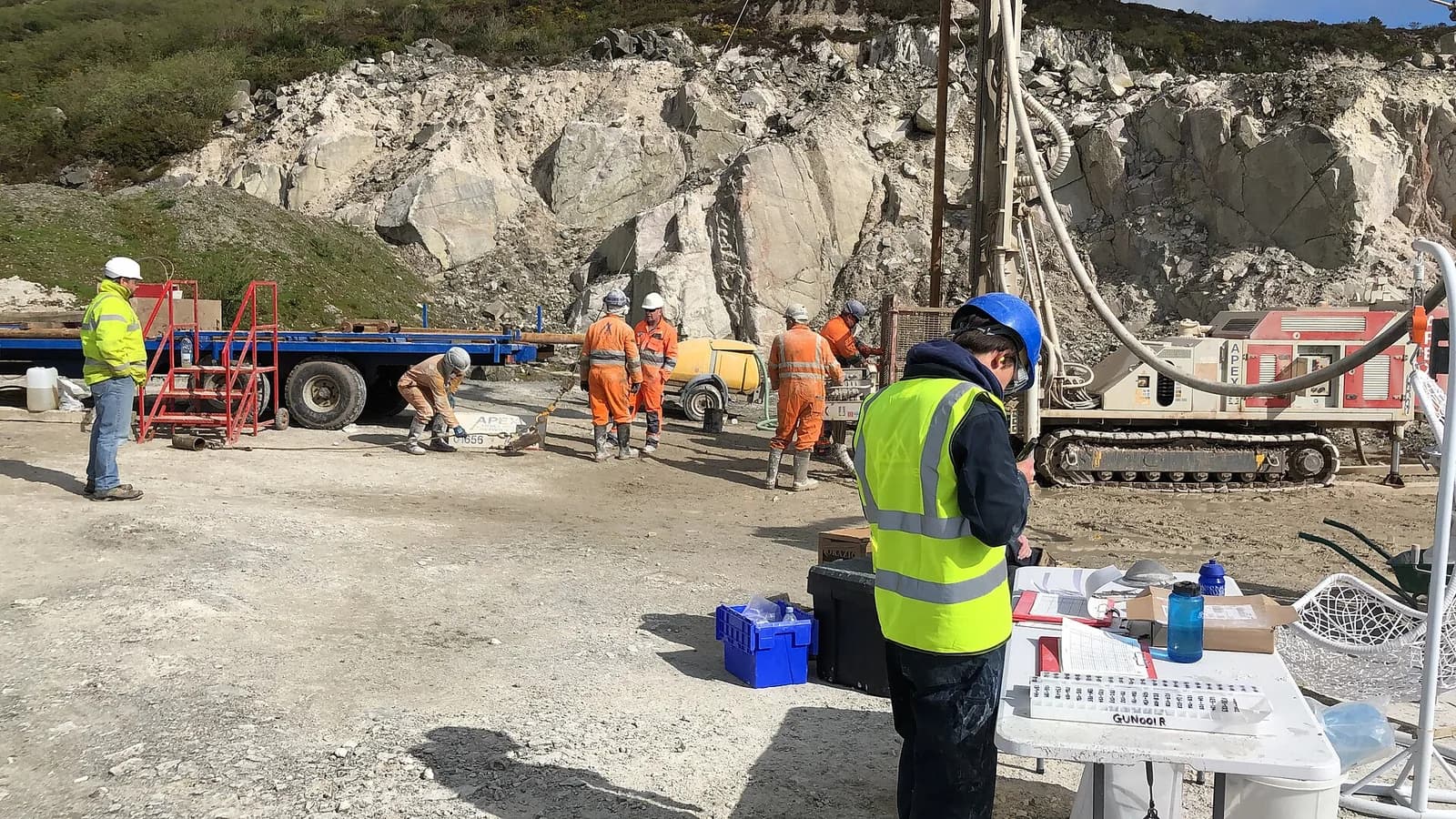
- Exploration proper — detailed information on the location, shape, dimensions, distribution, quality and measured resources of the deposit, plus information on the social and natural environment (Art. 1(18));
- Feasibility study — the full economic and technical case for mining, including the environmental impact analysis and post-mining planning (Art. 1(19)).
So an exploration IUP is not a licence to drill and wait. It is a licence to carry the ground all the way to an approved feasibility study, within a fixed term.
How long you get
| Commodity group | Exploration term (IUP) | Source |
|---|---|---|
| Metal minerals (nickel, copper, gold, bauxite, tin and others) | 8 years | PP 96/2021 Art. 42(a) |
| Coal | 7 years | Art. 42(e) |
| Certain non-metal minerals (e.g. gemstones; limestone, clay and quartz sand for cement) | 7 years | Art. 42(c) |
| Non-metal minerals | 3 years | Art. 42(b) |
| Rock | 3 years | Art. 42(d) |
The special licence (IUPK) used in state-reserved areas carries the same terms for its two commodity groups: 8 years for metal minerals and 7 years for coal (Art. 98). For the difference between the two licence types, see [IUP vs IUPK](/en/news/iup-vs-iupk).
What follows the clock matters as much as the clock. If exploration succeeds, the operation-production term is up to 20 years for metal minerals or coal, and 30 years where metal mining is integrated with a processing or refining facility (Art. 43, as amended by PP 39/2025).
Getting in: the guarantee you post on day one
Metal and coal exploration ground is obtained by auction or, since PP 39/2025, by priority allocation to defined groups (amended Art. 17(3)–(4)). For how the auction works, see our [licence auction explainer](/en/news/indonesia-mining-licence-auction).
Ministerial Regulation 18/2025, set on 14 November 2025, fixes what an auction winner must do next (Art. 14):
- pay the full data-information compensation bid within 7 working days of the winner being announced;
- place an exploration seriousness guarantee (*jaminan kesungguhan pelaksanaan kegiatan Eksplorasi*) within the same 7 working days; and
- apply for the exploration IUP through the government's OSS licensing system within 10 working days.
Missing any of the three means the winner is treated as having withdrawn.
The guarantee is a time deposit at a state-owned bank in the name of the Minister on behalf of the winner, sized by area (Art. 14(3)):
- Rp50,000,000 flat where the licence area is 40 hectares or less;
- Rp1,500,000 per hectare of the whole area where it is larger than 40 hectares.
As an illustration of the formula only, a 1,000-hectare metal-mineral block would require Rp1.5 billion on deposit before the licence is even issued.
The guarantee is not a formality. Government Regulation 19/2025 on the energy ministry's non-tax revenue lists the exploration seriousness guarantee as state revenue where the IUP or IUPK holder does not carry out exploration (Art. 2(1)(o)). In plain terms: do not explore, and the deposit goes to the treasury.
On top of the guarantee, an exploration licence for metal minerals, coal or diamonds pays an annual land rent (*iuran tetap*) of Rp30,000 per hectare per year, doubling to Rp60,000 once the licence moves to operation production (PP 19/2025, Annex). Our [royalties explainer](/en/news/indonesia-mining-royalties) covers the rest of the fiscal stack.
Keeping it: the quarterly test
This is the part foreign readers most often miss. Ministerial Regulation 18/2025 Art. 62 provides that:
- a holder must begin exploration promptly once its exploration-stage RKAB (annual work plan and budget) is approved;
- exploration must be reported every three months;
- a holder that does not report is subject to administrative sanctions; and
- where a holder does report but three consecutive reports show no exploration progress, the exploration IUP or IUPK may be revoked.
Three quarters is nine months. On paper, a licence can be lost inside its first year for doing nothing on the ground. For what goes into the RKAB that starts the clock, see [what is RKAB](/en/news/what-is-rkab-indonesia).
Extending it: one year at a time, on stated grounds
When the term runs out before the work is finished, PP 39/2025 rewrote the extension rule (amended Art. 53). An IUP holder may be granted an extension of the exploration stage of one year each time, on these requirements:
- a report on the exploration carried out, including technical or social obstacles met along the way;
- the extension is needed to complete other required permits;
- the holder has prepared mobilisation of the necessary equipment or infrastructure;
- an exploration work plan and budget across the whole licence area; and
- an exploration seriousness guarantee placed at a state bank.
The application must reach the Minister no later than 45 calendar days before the exploration term ends. The Minister may refuse it, and a refusal must be delivered before the term ends.
Ministerial Regulation 18/2025 Art. 63 adds that the extension must meet at least one of three criteria: it is needed to settle outstanding non-tax state revenue obligations; the holder already has exploration equipment in the field; and/or it is needed to build supporting infrastructure, including for exploration. The Minister decides within 14 working days of a complete application.
The same article states the consequence at the other end: where a holder did no exploration at all, or its extension is refused, the licence area is returned to the state.
Getting out: the feasibility study and the move to production
An exploration-stage holder moves to production only with the Minister's approval of an upgrade (PP 96/2021 Art. 36). The technical file is a proposed production-area map with coordinates, the complete exploration report, and a feasibility study already approved by the Minister (Art. 38). The environmental file is the environmental approval plus reclamation and post-mining plans (Art. 39). The financial file is three years of audited accounts, a tax clearance letter and proof that the last year's exploration land rent has been paid (Art. 40). The application is due at least 30 calendar days before the exploration term ends (Art. 41).
Ministerial Regulation 18/2025 Art. 63(7) softens one point: a holder that has an approved feasibility study over part of its area may still apply for a production licence, provided it carries an obligation of further exploration on the rest.
Exploration does not stop at production
Once in production, an IUP holder must carry out further exploration every year to find new reserves in its licence area, and must set aside an annual budget as a reserve resilience fund (*dana ketahanan cadangan*), the amount proposed in its RKAB (PP 96/2021 Art. 48, as amended by PP 25/2024). The duty can be waived only where the Minister has evaluated the holder as already having reserve data over its whole production area. Breaching Art. 48(1) or 48(3) is listed among the violations carrying administrative sanctions, up to revocation (Art. 185, as amended by PP 39/2025).
Why exploration status decides whether you can buy in
For an investor, the most consequential exploration rule is in the transfer provisions. A holder may not transfer its IUP, and an IUP-holding company may not transfer its shares, without the Minister's approval — and approval may be given only after the holder has completed exploration, evidenced by resource and reserve data, with a final exploration report attached (PP 96/2021 Arts. 10 and 13).
In other words, Indonesian law does not let an exploration licence be flipped before the ground has been measured. That shapes every early-stage deal: an investor entering before resources are reported is usually entering through a contract with the holder rather than through a registered share purchase. How resources and reserves must be reported is covered in our [resource and reserve reporting explainer](/en/news/indonesia-mineral-resource-reserve-reporting), and the deal mechanics in [how to buy a mine in Indonesia](/en/news/how-to-buy-a-mine-in-indonesia).
The state is exploring too
The government has said it will do more of the early work itself. At a hearing with House Commission XII on 3 September 2025, Deputy Energy Minister Yuliot Tanjung said exploration would be stepped up with state-budget support, rather than left largely to business entities, whose exploration often takes a long time (Kontan). For 2026 the ministry's Geological Agency (Badan Geologi) received Rp1.82 trillion, including additional allocations of Rp202.30 billion for mineral exploration, Rp156.16 billion for coal exploration and Rp40.99 billion for a mineral drilling vessel (ANTARA; Tempo; Kontan reports the vessel at Rp40.8 billion).
That matters because government survey results are the first listed source of new licence areas. As amended by Ministerial Regulation 12/2026, the regulation lists the origins of metal and coal licence areas as: government investigation and research; areas returned or relinquished by holders; licences that expired or were revoked; former contract areas; research by assigned companies; governors' proposals; and other areas with geological potential (Permen ESDM 18/2025 Art. 2(3), as amended).
Catatan Teramine
*This section is editorial analysis, not a statement of fact.*
- The 2025 rules turn exploration licences into use-it-or-lose-it assets. The quarterly no-progress test, the cash guarantee that is forfeited if no exploration is done, and the explicit return of idle ground to the state all point the same way. A licence bought "to hold" now carries a measurable cost and a measurable deadline.
- Ask for the quarterly reports, not just the licence. When screening an exploration-stage asset, the licence certificate shows only that the right exists. The RKAB approval, the quarterly exploration reports and the guarantee deposit slip show whether it is still safe. Three thin reports in a row is a red flag under Art. 62(4).
- Check where the clock stands. An eight-year metal licence in year seven, with no approved feasibility study, can only be saved by one-year extensions on the grounds listed above. The price should reflect that.
- More state-prepared ground is likely to come to market. If the Geological Agency's larger 2026 exploration budget is spent as announced, it should feed more surveyed areas into auction and priority allocation. Whether that happens, and how quickly, depends on decisions the texts do not fix.
What this article does not cover
- Radioactive minerals and rare earths. These have separate rules and are outside this piece.
- Forestry and land access for drilling. Exploration inside forest areas needs its own approvals; see [mining in forest areas](/en/news/indonesia-mining-in-forest-areas).
- Regional practice. Where licensing has been delegated to provinces for certain commodities, local procedure may differ from what is described here.
If you need help with an exploration RKAB, an extension application or a move to production, see our [permit services](/en/layanan-izin). To look at exploration-stage and producing assets on offer, browse the [marketplace](/en/marketplace).