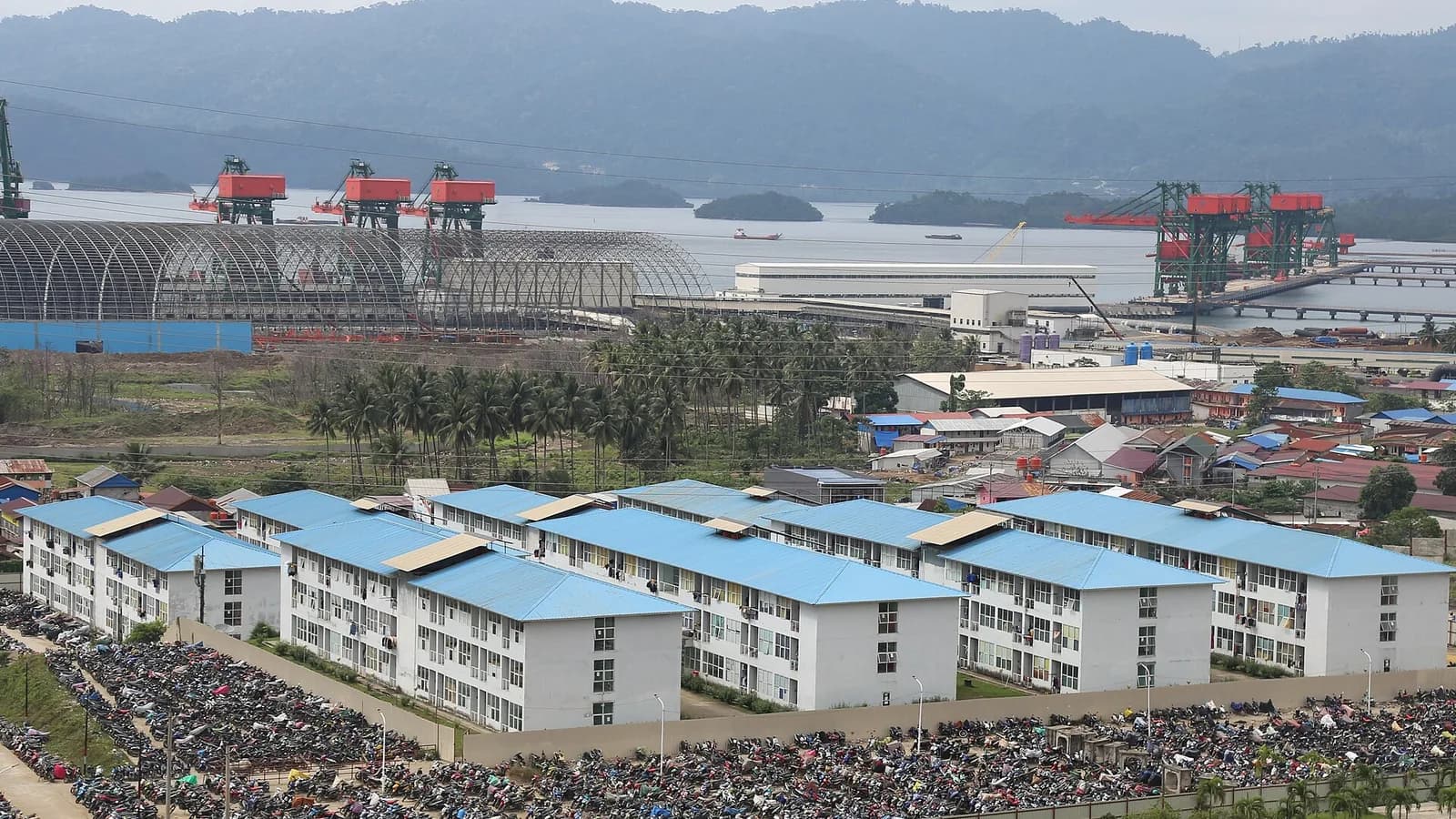
A nickel smelter in Indonesia usually does not buy its electricity from the state utility. It makes its own, most often from coal, in a power plant inside the same industrial park. Industry calls this captive power: electricity a company generates for its own use, off the national grid.
That kind of plant only exists because of one exception in a 2022 presidential regulation. If you are looking at a smelter, a nickel project that sells ore to one, or a share in an industrial park, the exception and the conditions attached to it shape the project's power supply for its whole life. This article goes through the regulation text clause by clause.
For how the smelters work (RKEF, HPAL, MHP, NPI), see [nickel smelters in Indonesia](/en/news/nickel-smelter-indonesia). This piece covers only the power supply.
The rule: new coal plants are banned, with two exceptions
Presidential Regulation (Perpres) No. 112 of 2022 on accelerating renewable energy for electricity supply was set and promulgated on 13 September 2022 and is listed as in force in the BPK legal database. Article 3(4) bans the development of new coal-fired power plants (PLTU), with two exceptions:
- (a) plants already included in a utility's electricity supply business plan (RUPTL) before the regulation took effect; or
- (b) plants that meet all three of the following conditions.
| # | Condition in Art. 3(4)(b) | What it means in practice |
|---|---|---|
| 1 | Integrated with industry built to add value to natural resources, *or* part of a National Strategic Project (PSN) that contributes significantly to jobs and/or national economic growth | Processing plants (nickel, bauxite, copper and others) are the main users |
| 2 | Commits to cutting greenhouse-gas emissions by at least 35% within 10 years of starting operation, measured against the 2021 average emissions of Indonesian coal plants, through technology, carbon offsets and/or renewable energy in the mix | A commitment made at the start, with the result measured over the plant's first decade |
| 3 | Operates no later than 2050 | A hard end date, whenever the plant was commissioned |
The conditions are cumulative ("dan" in the text): a plant that is integrated with a smelter but has no emissions commitment does not qualify.
The 2025 roadmap kept the exception word for word
In April 2025 the Ministry of Energy and Mineral Resources (ESDM) issued Permen ESDM No. 10 of 2025, the electricity-sector energy transition roadmap that Perpres 112 told the Minister to prepare. It was signed on 10 April 2025 and, according to the JDIH ESDM abstract, came into force when promulgated on 15 April 2025.
Article 6 of the 2025 regulation repeats the ban on new coal plants and the same exceptions: plants already in the RUPTL before Perpres 112, or plants that are industry-integrated or PSN, commit to the 35% cut within 10 years, and stop by 2050. Investors hoping the exception would be narrowed should note that the 2025 text left it unchanged.
The roadmap annex gives a figure that shows how large captive power has become. It projects that CO2 emissions from power generation will peak in 2037 at about 599 million tonnes: about 433 million tonnes from the grid and about 166 million tonnes from captive plants. It projects total emissions falling from 2038, reaching near zero in 2058 and zero from 2059.
Early retirement is written around PLN, not captive plants
Most of Permen 10/2025 deals with early retirement of coal plants: the criteria (capacity, age, utilisation, emissions, economic value, available funding and technology, plus system reliability, tariff impact and a just transition), a PLN study to be finished within six months of assignment, a joint evaluation team, and written approval from the finance and state-enterprise ministers before the Minister names a plant.
That process is built around PLN's own plants and PLN's power-purchase agreements with independent producers. Article 16 refers to amending the PPA between PLN and the developer. In the text we read, there is no equivalent procedure or retirement timetable for captive plants. For captive coal, the binding limits are still the Article 6 conditions: the 35% commitment and the 2050 end date.
How much captive coal is there?
The government has not published an official count of captive coal capacity alongside the regulation. The most-cited independent tally comes from the Centre for Research on Energy and Clean Air (CREA) and Global Energy Monitor (GEM), published in January 2026:
| Status | Capacity (GEM/CREA, Jan 2026) |
|---|---|
| Operating | 19.3 GW |
| Under construction | 3.6 GW |
| In planning (expansion) | 8.16 GW |
| Total operating + planned | about 31 GW |
The same report says captive coal made up about 80% of all new coal additions in Indonesia between GEM's July 2024 and July 2025 data releases. It says the growth is concentrated in the nickel hubs of Central Sulawesi and North Maluku, where captive capacity has grown 2.25-fold since 2023.
GEM and CREA also say there is currently no public evidence or monitoring framework to check whether captive units are meeting the 35% reduction commitment. That is the authors' assessment, not a government statement. Their numbers also differ from the JETP Secretariat's Captive Power Thematic Report (November 2025). A February 2026 editorial note on the GEM report explains that JETP's figures were 5.5 GW under construction and 3.1 GW planned when it was released, and that JETP ran an asset-level alternatives analysis covering 4.452 GW across ten projects. When you see a capacity figure, check which dataset and cut-off date it comes from.
The renewable side of the same regulation
Perpres 112 also matters for smelters that want to move away from coal. Under Article 11, PLN may buy excess electricity from holders of a self-use electricity licence that generate from renewable sources. The purchase is set out in a separate excess-power agreement with a term of at least three years, which can be extended. PLN is permitted to buy, not required to, and its decision has to take account of supply and demand on the system.
The JETP Secretariat's description of its captive power study states the commercial pressure: most captive generation still runs on coal, which it says creates higher emissions and growing market and financing risks as global supply chains move toward cleaner production.
Timeline
| Date | Event |
|---|---|
| 13 Sep 2022 | Perpres 112/2022 set and promulgated: ban on new coal plants, with the industry/PSN exception and three conditions |
| 10 Apr 2025 | Permen ESDM 10/2025 (electricity transition roadmap) signed |
| 15 Apr 2025 | Permen ESDM 10/2025 promulgated and in force; Art. 6 repeats the exception |
| 19 Nov 2025 | JETP Secretariat publishes its Captive Power Thematic Report |
| Jan 2026 | GEM/CREA report: about 31 GW of captive coal operating and planned |
| 2037 | Roadmap's projected peak in power-sector CO2 (about 166 Mt of it captive) |
| 2050 | Latest date any exempted coal plant may operate |
What to check if a project depends on captive coal
- Which exception applies. Was the plant in a RUPTL before September 2022, or does it rely on the industry-integration/PSN exception? Only the second carries the 35% and 2050 conditions.
- The emissions commitment. Ask for the document recording the 35% commitment, the 2021 baseline used, and how the reduction will be achieved (technology, offsets, renewables).
- Commissioning date. The 10-year clock for the 35% cut starts at commissioning, so it tells you when the commitment falls due.
- Life beyond 2050. If the processing plant's design life goes past 2050, its power supply needs a replacement plan.
- Renewable options. Check whether the park could sell excess renewable power to PLN under Article 11, and whether the local grid can take it.
A broader pre-investment verification list is in our [Indonesia mining due diligence checklist](/en/news/indonesia-mining-due-diligence-checklist).
Catatan Teramine
*This section is Teramine's editorial analysis, not a statement of fact or a source's position.*
The captive-coal exception explains much of why Indonesia's nickel processing grew so fast: smelters could build their own cheap baseload power without waiting for the grid. The same regulation also attaches two obligations to every new exempted plant. The first is a deadline: no exempted coal plant may run past 2050. The second is a performance commitment: a 35% emissions cut against a national baseline within ten years. For a smelter commissioned in the mid-2020s, the 35% deadline falls in the mid-2030s, around the time the government's own roadmap expects power-sector emissions to peak.
For investors, we see three practical consequences. First, power-supply risk belongs in the valuation: a model that assumes captive coal on today's terms through the 2050s is not consistent with the regulation. Second, the 35% commitment carries a cost — offsets, co-firing or renewable capacity — that the project's operating costs should include, even though the text sets no price. Third, the lack of a public monitoring framework that GEM and CREA describe cuts both ways. Enforcement may be light now, but rules with a fixed date and a number attached are easy to tighten, and buyers checking supply-chain emissions may ask for the evidence before regulators do.
None of this makes captive-powered projects uninvestable. It means the power plant should be diligenced as carefully as the ore body. If you are assessing a specific asset, Teramine's [permit services](/en/layanan-izin) can help verify its licensing position, and the [marketplace](/en/marketplace) lists projects open to investment.
Sources read for this article
- Perpres No. 112 of 2022 (full text, JDIH BPK): Arts. 3(1), 3(4)–(9), 11; dates and status from the JDIH BPK record.
- Permen ESDM No. 10 of 2025 (full text and abstract, JDIH ESDM): Arts. 2, 6, 11–16 and the roadmap annex.
- JETP Secretariat, Captive Power Study briefing (19 November 2025).
- Global Energy Monitor and CREA, *Out of Sight, Out of Control* (January 2026), including its 4 February 2026 editorial note.